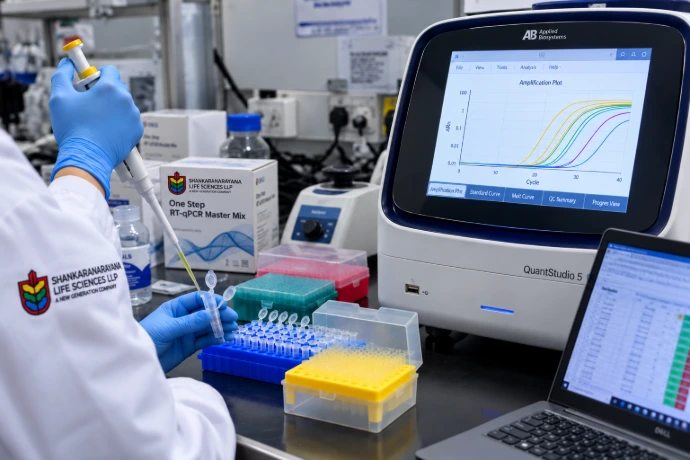
Assay Design & Development
SNLS develops customized PCR, RT-PCR, RT-qPCR and multiplex molecular assays from initial target selection through optimized assay design. Our approach combines bioinformatics, primer–probe development and experimental optimization to build assays suited to the intended target, specimen type and application.
Target Identification & Bioinformatics
Suitable genomic targets are identified and evaluated for conservation and specificity. Sequence analysis helps select appropriate regions for primer and probe development while reducing the possibility of non-specific detection.
Primer–Probe Design & Assay Optimization
Primers and probes are designed for the selected molecular platform and experimentally optimized for reaction chemistry, amplification performance, thermal conditions and signal quality. Single-target assays can also be developed and optimized before integration into multiplex formats.
Assay Integration & Validation
Once the core assay is established, SNLS focuses on integrating internal controls, multiplex targets, sample-preparation compatibility and analytical evaluation to create a more complete and reliable molecular testing workflow.
Internal Controls & Multiplex Integration
Endogenous, exogenous, extraction or amplification controls can be incorporated according to the assay requirement. For multiplex assays, target combinations, fluorophores and detection channels are optimized to maintain balanced and specific amplification.
Analytical Evaluation & Prototype Development
Optimized assays are evaluated for performance and compatibility with the intended specimen and extraction workflow. The final assay can then be translated into a prototype kit configuration with defined reagents, controls, reaction conditions and preliminary QC requirements for further validation and manufacturing transfer.